 Deutsch
  Japanese
  English
  Korean
  français
  español
  русский
  português
  Italia
Zinc die casting is a high-pressure manufacturing process that injects molten zinc alloy into a hardened steel die, where it cools and solidifies into a net-shape or near-net-shape metal component. For product engineers and sourcing teams, the practical question is whether a part's shape, material requirement, tolerance strategy, surface-finish needs and annual volume fit the die-casting window. Zinc die casting is often effective for relatively complex, high-volume non-ferrous parts such as housings, brackets, handles, hardware, locks and small mechanical components where fast cycle times and thin-wall capability matter. When the part is very small, extremely intricate, needs ultra-tight machined features, or requires a high-strength/corrosion-resistant alloy, other routes such as Metal Injection Molding (MIM) or CNC should be reviewed as possible alternatives rather than assuming die casting remains the lowest-risk route.
Core route Zinc alloy melting, high-pressure die injection, cooling, ejection and selected secondary operations.
Best fit Complex thin-wall non-ferrous parts, high-volume production, decorative surfaces, housings, hardware and small mechanisms.
Main limits Non-ferrous alloy range, porosity risk, tooling cost, and less suitable for ultra-fine or very high-strength small features.
Next decision Use MIM when small complex parts, high density, tight machined features or a ferrous/stainless material requirement makes process selection uncertain.
What Is Zinc Die Casting?
Zinc die casting is a manufacturing process in which molten zinc alloy is forced under high pressure into a reusable steel die cavity. The metal fills the cavity rapidly, cools and solidifies to form a component with good dimensional accuracy and fine surface detail. After ejection, the part may receive trimming, machining, plating or painting as secondary operations.
This process belongs to the broader die-casting family (zinc, aluminum, magnesium), but zinc has specific advantages: low melting point (~419°C), excellent castability, thin-wall capability, high dimensional accuracy and easy plating/finishing. It is used widely for hardware, automotive trim, locks, electrical housings, handles and small mechanisms where fast cycle times and fine surface reproduction are required.
Zinc die casting vs MIM in one sentence: Zinc die casting is usually better for relatively large, thin-wall, high-volume non-ferrous parts with fast cycles and decorative finishes. MIM is usually reviewed when the part is very small, complex, needs a ferrous/stainless alloy or high-density strength, or would require excessive machining after casting.
The right route should not be selected by material name alone. In practice, the decision depends on part geometry, material requirement, density expectation, surface-finish requirement, tolerance strategy, annual volume and how much secondary machining would be needed.
How the Zinc Die Casting Process Works
The zinc die casting process generally consists of melting the zinc alloy, injecting it at high pressure into a hardened steel die, allowing it to cool and solidify, then ejecting the part and performing selected secondary operations. From a project review perspective, each step affects final geometry, strength, surface quality, porosity and cost.
Zinc Alloy Melting and Holding
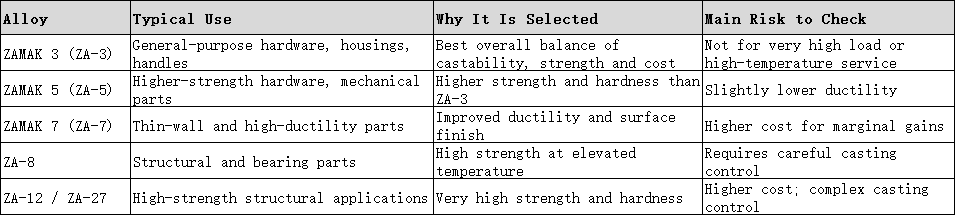
The process begins with melting zinc alloy ingots (typically ZAMAK alloys such as ZA-3, ZA-5 or ZA-8) in a holding furnace at controlled temperature. Alloy composition and melt temperature affect fluidity, castability, mechanical properties and finishing quality. Molten zinc has low viscosity, which allows thin walls and fine detail reproduction.
High-Pressure Injection into the Die
Molten zinc is injected into the hardened steel die cavity under high pressure. The die determines the part shape, surface finish and dimensional accuracy. Because zinc solidifies quickly, cycle times are short and production rates are high.
Cooling, Solidification and Ejection
The metal cools and solidifies in the die, then the part is ejected. Zinc's fast solidification supports thin walls and intricate features, but also makes it important to control gate, runner, venting and cooling design to avoid porosity and surface defects.
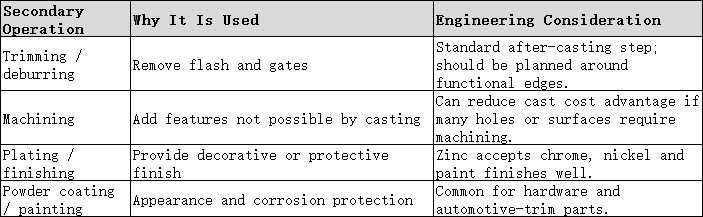
Secondary Operations: Trimming, Machining, Plating, Painting
Zinc die castings often use secondary operations to improve dimensional accuracy, surface condition or appearance. These operations can be valuable, but they also affect total manufacturing cost.
Common Zinc Die Casting Alloys
Material selection should follow the part function and service environment. ZAMAK alloys are the most common, with ZA-8 and ZA-12 offering higher strength for structural parts.
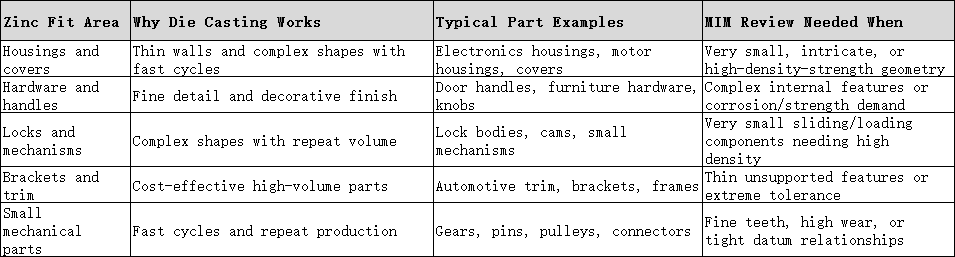
Where Zinc Die Casting Performs Well
Zinc die casting performs well when the part has complex thin-wall geometry, high production volume and a need for fine surface detail, decorative finish or fast cycle times. For sourcing teams, the important point is that zinc's value is not only "low cost." Its value depends on how well the part's geometry and functional requirements match high-pressure die casting.
Where Zinc Die Casting Has Design Limits
The most important limitation of zinc die casting is not that it cannot make useful parts. It can. The limitation is that the geometry and material must be compatible with molten-metal filling, solidification, die ejection, porosity control and secondary operations.
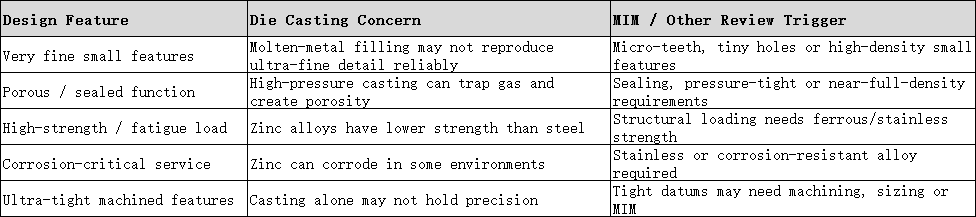
Common Design Features That Increase Zinc Die Casting Review Risk
Porosity Is a Core Concern
During high-pressure injection, air or gas can become trapped in the molten metal and create porosity inside the part. This porosity can affect strength, leak-tightness, plating quality and machined surfaces. Porosity control depends on die design, gating, venting, machine parameters and part geometry — and should be reviewed early rather than discovered during sampling.
Density and Strength Are Lower Than Steel
Zinc die castings are dense relative to their weight but cannot match the strength, hardness and fatigue behavior of steel or stainless steel. If a part carries structural load, slides under wear or needs hardenability, zinc die casting may not be the right route and MIM in a steel/stainless alloy should be reviewed.
Zinc Die Casting vs MIM: Same Precision Goal, Different Material Window
Zinc die casting and MIM are related in that both form complex metal parts at volume, but the material and forming logic differ. MIM should not be promoted as a replacement for every die-cast part. If a shape can be made efficiently as a zinc casting, die casting may remain the better route. MIM is usually reviewed when the part's small size, ferrous/stainless material requirement, high-density strength or machining reduction justifies a different process.
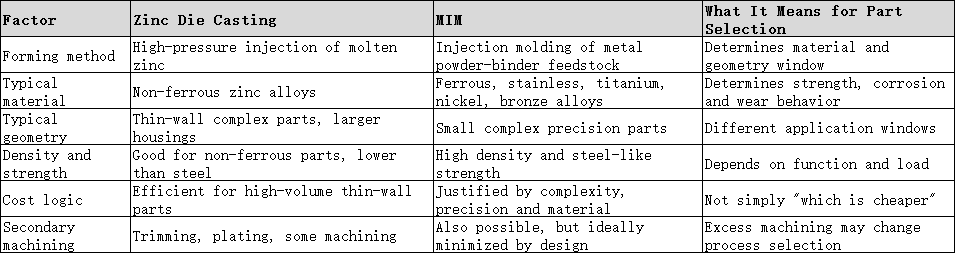
Selection boundary: The real question is not whether die casting or MIM is more advanced. The real question is which route controls geometry, material, density, tolerance, surface finish, secondary operations, lead-time risk and production cost with less uncertainty.
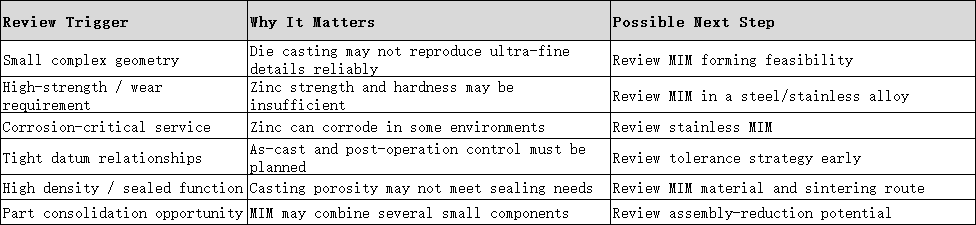
When Should a Zinc Die Cast Part Be Reviewed for MIM?
A zinc die cast part should be reviewed for MIM when the cost or risk is no longer controlled by the casting process itself, but by porosity correction, secondary machining, strength limitations or repeated design compromise.
Composite Field Scenario for Engineering Training: Die-Cast Part Needing Steel Strength
What problem occurred: A small mechanism component was originally planned for zinc die casting because the shape was complex and volume was suitable.Why it happened: The part carried repeated sliding load and required wear resistance that zinc could not provide.What the real system cause was: The material was selected for castability, not for the actual wear and strength function.How it was corrected: The design was reviewed as a MIM candidate in a hardenable steel, comparing die-cast cost plus rework against MIM tooling and heat treatment.How to prevent recurrence: Review functional load, wear, strength and material behavior before confirming a die-cast material.
Composite Field Scenario for Engineering Training: Thin-Wall Housing Correctly Kept as Die Casting
What problem occurred: A buyer considered moving a thin-wall housing from zinc die casting to MIM because the part was complex.Why it happened: The team focused on complexity but did not evaluate the thin-wall non-ferrous geometry and decorative finish.What the real system cause was: The process was selected based on complexity alone, not on material, wall thickness, surface finish and cycle time.How it was corrected: The part remained a zinc die casting because it matched the material, thin-wall and finish requirements better than a high-density MIM route.How to prevent recurrence: Process selection should consider material, geometry, density, surface finish, annual volume and secondary operations together.
China Custom Metal Parts manufacturer Harbermetal
Many engineers choose a manufacturing route by material name or part size alone, then discover after tooling that porosity, strength limits or excessive machining push every fix onto their schedule. You don't need to guess which route fits your part. Send your 2D/3D drawings, material requirements, load and surface-finish needs to Harbermetal. Our engineering team runs an impartial drawing-based process review — telling you honestly whether zinc die casting, MIM or another route is the most economical path before you invest in any tooling.
Harbermetal is an ISO-certified full-chain China custom metal parts manufacturer — a real manufacturer, not a trading intermediary. Our core specialty is Metal Injection Molding, and we coordinate qualified non-ferrous casting resources so our engineers can recommend the most suitable route for your project rather than pushing a single process.
Our engineering team reviews every incoming drawing against material suitability, geometry risk, wall balance, density and porosity requirements, surface-finish strategy, tolerance and secondary-operation load. We produce custom components in stainless steels (304L, 316L, 17-4PH, 420, 440C), low-alloy steels, bronze, soft-magnetic alloys, titanium and nickel-base alloys for automotive hardware, power-tool components, lock systems, consumer electronics, wearable devices and non-implant medical-instrument hardware. We provide first-article inspection reports, density/hardness/metallographic test records and full batch-traceability documentation from prototype validation to high-volume serial production.
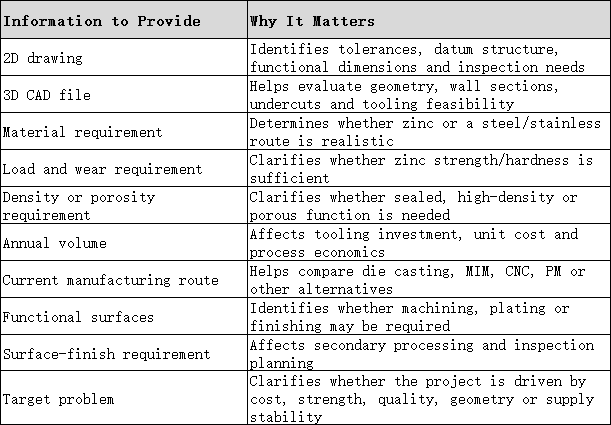
What Information Should You Prepare Before Comparing Zinc Die Casting and MIM?
For sourcing teams, a useful die-casting vs MIM review starts with project information, not with a process preference. The same part may look suitable for zinc die casting at first, but after reviewing geometry, tolerance, material, density and machining requirements, the best route may change.
FAQ
Is zinc die casting the same as MIM?No. Zinc die casting injects molten zinc alloy into a steel die; MIM injects a metal powder-binder feedstock and then debinds and sinters. Die casting is a non-ferrous casting process, while MIM produces small complex parts from ferrous, stainless, titanium and other powder routes.
When is zinc die casting better than MIM?Zinc die casting is often better when the part is a thin-wall, relatively larger non-ferrous component, produced at high volume, and benefits from fast cycles and decorative finishes. Housings, handles, hardware, trim and small mechanisms are common candidates.
When should a die-cast part be reviewed for MIM?A part should be reviewed for MIM when it is very small, needs steel/stainless strength or wear resistance, has porosity/sealing problems, ultra-fine features, tight datums, or excessive machining after casting.
What are the main zinc die casting alloys?Common alloys include ZAMAK 3, ZAMAK 5, ZAMAK 7, and the ZA series (ZA-8, ZA-12, ZA-27), selected for castability, strength, ductility and temperature requirements.
What are the main limits of zinc die casting?Main limits include porosity risk, lower strength and hardness than steel, corrosion limitations in some environments, and less suitability for ultra-fine or very high-load small features.
Does zinc die casting always cost less than MIM?No. Die casting can be more economical for high-volume thin-wall non-ferrous parts. However, if a part needs rework for porosity, machining, strength or sealing, MIM may become worth reviewing. Compare total manufacturing cost, not only the initial casting cost.
What information should I send for a zinc die casting vs MIM review?Send the 2D drawing, 3D CAD file, material requirement, load and wear requirements, tolerance requirements, density or porosity requirement, surface-finish needs, annual volume, current manufacturing route and application background.
Review a Zinc Die Cast Part for the Right Manufacturing Route
If your current zinc die cast part is becoming difficult to make, expensive to machine, or limited by strength or porosity, Harbermetal can review whether MIM is a practical alternative.
Please send 2D drawings, 3D CAD files, material requirements, load and wear expectations, density or porosity expectations, tolerance and datum requirements, surface-finish needs, estimated annual volume, current manufacturing route and application background. Our engineering review can check geometry feasibility, material suitability, porosity risk, tolerance strategy, secondary-operation needs and whether the part should stay with die casting or move into a MIM comparison review.
Contact information
Email: sales@harber-mim.com
Tel: +86 0769-82389116
Ready to determine the right manufacturing route for your custom metal part? Submit your drawings and functional specifications for a free process review and transparent quotation.
Request A Free Quote