
 Deutsch
  Japanese
  English
  Korean
  français
  español
  русский
  português
  Italia
MIM-4140 Low Alloy Steel MIM Parts
MIM-4140 is a low alloy steel material direction used in metal injection molding, based on the classical 4140 chromium-molybdenum steel chemistry. Chromium and molybdenum are the principal alloying elements associated with hardenability, strength and toughness after heat treatment. MIM-4140 is considered when strength, toughness, wear resistance and heat-treatment response are required together in small complex steel parts.
For metal injection molding, the key question is whether the selected 4140 powder/feedstock route, molding behavior, debinding, sintering shrinkage, density, heat-treatment response, critical dimensions and inspection plan can be controlled consistently enough for production. This page explains the material basics first, then shows when MIM-4140 may be practical, when MIM-316L, 17-4PH, other alloy steels, CNC or another route may be safer, and what to review before tooling.
What MIM-4140 means A low alloy chromium-molybdenum steel direction for MIM; exact grade, chemistry and acceptance criteria must be specified.
When MIM may fit Small complex steel parts where strength, toughness, wear and heat-treatment response appear together with repeat-production value.
Review before tooling Chemistry, powder/feedstock, density, carbon control, heat-treatment response, functional surfaces, inspection, intended use and annual volume.
What Is MIM-4140 Low Alloy Steel?
4140 is a chromium-molybdenum low alloy steel grade widely used in bar, forging and machining form for its balanced strength, toughness and hardenability. MIM-4140 is the metal injection molding material direction built on the same alloying concept. It is not one universal MIM grade — the exact powder chemistry, carbon content, density, heat-treatment cycle and finished-part acceptance must be tied to the specified material direction and manufacturing route.
For an early engineering screen, 4140 steel is commonly described with approximately 0.38–0.43% carbon, 0.80–1.10% chromium and 0.15–0.25% molybdenum as the principal alloying elements, balanced with iron. Dense MIM-4140 parts typically target a sintered density close to that of wrought steel. These figures are reference directions only: the controlling grade, powder specification, actual chemistry, residual porosity, carbon control, sintering route, heat treatment and customer acceptance criteria determine the finished MIM part.
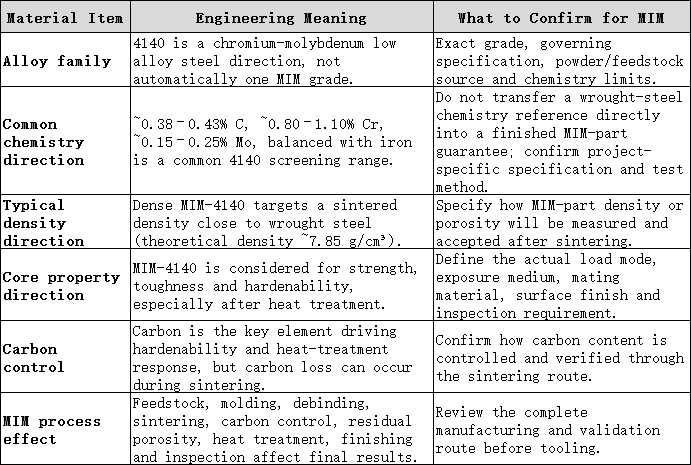
Material data boundary: Chemistry and density values above are screening directions for common 4140 steel, not guaranteed properties for every grade or finished MIM component. The customer drawing and material specification must control final acceptance.
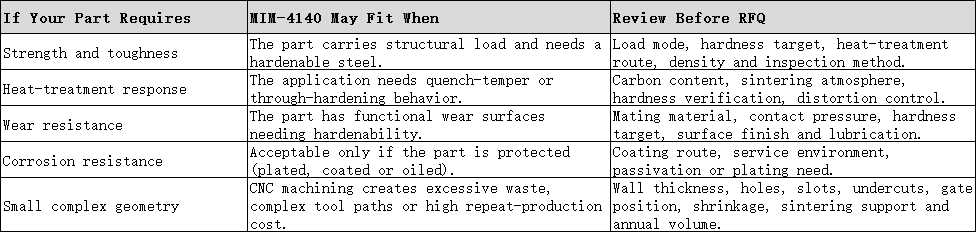
Quick Decision Table for MIM-4140 Parts
Use this table as an early screening tool before requesting a quotation. It does not replace drawing review, but it helps determine whether MIM-4140 should remain in the material discussion or whether another MIM material may be more practical.
When MIM-4140 Makes Sense for MIM Parts
MIM-4140 is usually reviewed for MIM when three conditions appear together: the part is small and geometrically complex, the application requires a hardenable low alloy steel, and the project volume or functional value justifies tooling and process validation.
MIM is relevant when the part has fine features, internal profiles, holes, slots, small bosses, curved surfaces or forms that would be expensive to machine from bar stock. For MIM-4140 projects, carbon control, densification and heat-treatment behavior matter because the material is often selected for functional strength, not appearance alone.
Small Complex Parts Where a Hardenable Steel Is Needed
MIM-316L stainless steel is often a more practical starting point for general corrosion resistance. MIM-17-4PH may be more practical for high-strength stainless MIM parts. MIM-4140 enters the discussion when the part needs a demanding combination of strength, toughness and wear resistance, and the service environment allows corrosion protection (coating, plating or oiling).
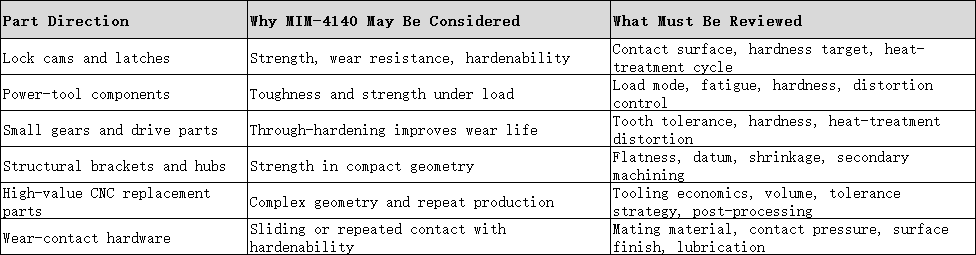
Structural small parts under load where hardenability matters.
Lock mechanisms, cams and latches where wear resistance is needed.
Power-tool components where toughness and strength are combined.
Gear and drive components where through-hardening improves wear life.
Small fasteners, hubs and brackets where cost-effective hardenable steel is preferred.
Applications That May Justify MIM-4140 Review
MIM-4140 should be discussed as a project-specific material option, not as a universal upgrade. The useful engineering question is whether the part function depends on a hardenable low alloy steel that a stainless or soft-magnetic route cannot reliably provide.
When MIM-4140 May Be Over-Specified or Risky
A common mistake is to specify 4140 steel because it sounds stronger than stainless steel, without reviewing whether corrosion protection is available or whether heat treatment is actually needed. That can make the project more expensive, slower to validate and harder to quote without improving the finished part.
When Another Material or Process May Be More Practical
| Requirement | Often More Practical First Review | Why |
|---|---|---|
| General corrosion resistance | MIM-316L stainless steel | More common material route, often easier to source and validate |
| High-strength stainless structure | MIM-17-4PH stainless steel | Common high-strength MIM option after heat-treatment review |
| Wear and abrasive edge | MIM-420 or cemented carbides | Higher hardness-focused material family |
| High-temperature or severe corrosion | Nickel alloys for MIM | Stronger fit for high-temperature or severe corrosion environments |
| Unclear prototype-only requirement | CNC machining or metal 3D printing | Avoids special alloy tooling cost before design validation |
MIM-4140 becomes risky when the drawing does not clearly define the function of the part, whether corrosion protection is required, or what hardness and heat-treatment target the part must meet. If the application environment, mating surface, inspection standard, surface finish and critical dimensions are unclear, the supplier can only guess which characteristics matter.
Low-volume projects also require caution. MIM tooling, feedstock preparation, sintering validation and first-article correction cycles can be difficult to justify if the part is still in early concept testing. For early prototypes, CNC machining, additive manufacturing or soft tooling routes may be more practical until the geometry and performance requirements become stable.
MIM-4140, Alloy Steel Grades and Standard Material Directions
4140 is a well-known chromium-molybdenum steel direction, but MIM-4140 parts are not automatically equivalent to wrought 4140 bar. A wrought-steel standard provides chemistry and test context, but it should not be treated as an automatic finished-MIM-part approval. Finished MIM part acceptance must be defined by the customer drawing, material specification, inspection method, heat-treatment cycle, surface condition, intended use and project validation plan.
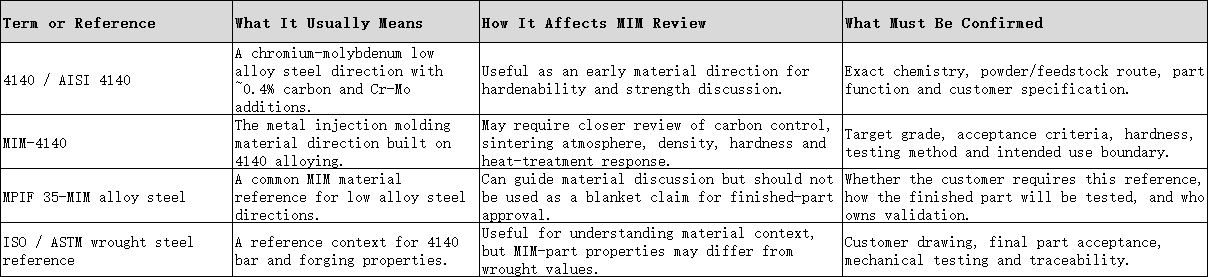
MIM-4140 requirements can guide material discussion.
Finished MIM part acceptance must be defined by the customer drawing and specification.
Carbon control and heat-treatment response are the key MIM-specific concerns.
A material name alone should not be treated as proof of finished-part compliance.
MIM-4140 Part Types and Engineering Fit
The best MIM-4140 projects are usually not simple blocks or large parts. They are small components where material performance and shape complexity both matter. From a design review perspective, a strong candidate usually has functional surfaces, compact geometry, repeat production demand and enough value to justify tooling and process development.

If only one condition exists — special alloy, complex geometry or repeat volume — the project needs more careful comparison before tooling. A MIM-4140 material name cannot compensate for an unstable design, unclear contact surface or unrealistic tolerance requirement.
How MIM-4140 Differs from Stainless Steel, Other Alloy Steels and Special Materials
Material comparison is often where project decisions become clearer. MIM-4140 should not be positioned as "better" than other MIM materials in general. It should be positioned as a specialized option for a specific balance of strength, toughness, hardenability and cost — with the understanding that it needs corrosion protection.

A useful material review does not ask, "Which material is strongest?" It asks which material best matches the part function, geometry, surface requirement, corrosion-protection plan, inspection method, production volume and cost target.
Manufacturing Risks in MIM-4140
MIM-4140 requires more engineering review than common stainless steel MIM because the material depends on carbon content and heat-treatment response. The manufacturing risk is not only whether the part can be molded. It is whether the complete route can deliver stable material behavior, carbon control, dimensions and hardness.
Powder and Feedstock Availability
The first review point is whether a suitable 4140 low alloy steel powder and feedstock can be sourced or prepared consistently. Powder size distribution, morphology, oxygen level, carbon level and batch stability can affect molding behavior, debinding, sintering, density and final hardenability.
The 4140 supply chain is generally easier to evaluate than more exotic alloys, but the project should still confirm material availability before finalizing tooling — especially if the customer requires a specific grade, chemistry range or carbon limit.
Carbon Control During Sintering
Carbon is the key element in 4140 that drives hardenability and heat-treatment response. During sintering in a reducing atmosphere, carbon can be lost from the part, which lowers the achievable hardness after heat treatment. Conversely, uncontrolled atmosphere can add carbon.
MIM-4140 parts should not be treated as if they can automatically use the same route as stainless steel. Sintering atmosphere, thermal profile, part loading and support strategy must be reviewed so that final carbon content stays within the required window.
Is the required carbon range defined by the customer or by a reference standard?
Is carbon control maintained through the sintering route?
Will the supplier confirm carbon content and hardness by appropriate inspection?
Is the heat-treatment cycle matched to the actual sintered carbon content?
Density, Surface Finish and Corrosion Protection
MIM-4140 parts typically need corrosion protection because low alloy steel rusts in normal service. The part may require plating, coating, oiling or blackening, which must be defined before tooling. Functional surfaces may also need machining, polishing or grinding.
As-sintered surfaces may be acceptable for some non-contact features. Contact areas, sealing surfaces or sliding surfaces may need post-processing. This should be discussed before tooling because secondary operations can change cost, dimensions and delivery planning.
Dimensional Stability and Heat-Treatment Distortion
MIM-4140 still involves shrinkage during sintering, and heat treatment adds an additional distortion risk. Critical dimensions, flatness, hole location and thin features should be reviewed with the same discipline used for other MIM materials, but with additional attention to heat-treatment distortion and post-processing.
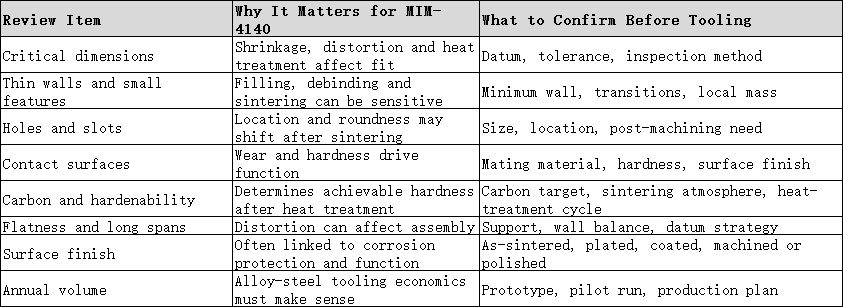
DFM Review Points Before Tooling a MIM-4140 Part
Before tooling, MIM-4140 parts should go through material and DFM review together. Separating the material decision from the geometry decision is a common source of cost and quality problems.
Representative Engineering Scenario: Undefined Carbon and Heat-Treatment Target
Scenario disclosure: This is a representative engineering scenario used to explain a recurring review risk. It is not presented as a specific customer project or Harbermetal production case.
What problem occurred: A small MIM-4140 part was reviewed for high strength, but the drawing did not define the required carbon range, hardness target or heat-treatment cycle.
Why it happened: The material was specified, but the hardness target, carbon-control expectation and corrosion-protection requirement were not clearly marked.
What the real system cause was: The project treated material selection as a substitute for defining the functional heat-treatment and hardness requirement.
How it was corrected: The drawing was updated to identify the hardness target, carbon range, heat-treatment cycle, corrosion-protection route and inspection method before tooling.
How to prevent recurrence: For MIM-4140 projects, mark carbon limits, hardness targets, functional surfaces, corrosion-protection requirements and critical dimensions before quotation.
Inspection and Validation Questions for MIM-4140 Projects
Inspection for MIM-4140 should be based on the part function, not on a generic checklist. Some projects may need dimensional inspection and surface review only. Others may require carbon confirmation, density review, hardness testing, heat-treatment verification, surface-finish inspection or customer-defined validation.
Material and Chemistry Confirmation
If the project refers to MIM-4140, MPIF 35-MIM alloy steel or a customer standard, the supplier should confirm which requirement controls the project. A standard name in an email is not enough. The drawing or technical specification should define the expected material direction, carbon range and acceptance method.
Density, Hardness and Heat-Treatment Requirements
The user should clarify whether the project requires carbon confirmation, density or porosity review, hardness testing, heat-treatment verification, surface-roughness inspection, visual acceptance criteria, burr and edge-condition review, post-processing verification, critical-dimension inspection or customer-specific quality documentation.
Corrosion-Protection Review Boundary
Because MIM-4140 is a low alloy steel, the corrosion-protection route (plating, coating, oiling or blackening) must be defined as part of the project. A supplier page can explain manufacturing feasibility, but it should not imply that the finished part is automatically suitable for a corrosive service environment without protection.
Representative Engineering Scenario: Heat-Treatment Target Not Defined
Scenario disclosure: This is a representative engineering scenario used to explain a recurring RFQ and validation risk. It is not presented as a specific customer project or Harbermetal production case.
What problem occurred: A MIM-4140 inquiry referenced a hardenable steel direction but did not include a hardness or heat-treatment target.
Why it happened: The buyer assumed that naming the material direction was enough for quotation and production planning.
What the real system cause was: The project had not separated material reference, heat-treatment cycle, surface finish, dimensional acceptance and final application requirements.
How it was corrected: The customer clarified the drawing revision, required carbon range, hardness target, heat-treatment cycle, inspection expectations and corrosion-protection route.
How to prevent recurrence: When a MIM-4140 inquiry is sent, the RFQ package should also include the application environment, critical dimensions, hardness target, surface-finish, corrosion-protection and inspection requirements.
China Custom Metal Injection Molding manufacturer Harbermetal
Many engineers specify a hardenable steel like 4140 for a small complex part, then discover after tooling that carbon loss during sintering or an undefined heat-treatment target leaves the hardness well below spec — and every correction lands on your schedule. You don't need to learn these lessons through expensive trial-and-error. Send your 2D/3D drawings, material requirements, hardness target and volume forecast to Harbermetal. Our engineering team runs a drawing-based material and DFM review — confirming carbon-control strategy, sintering route, heat-treatment cycle, corrosion-protection plan and dimensional risk — before you invest in any tooling.
Harbermetal is an ISO-certified full-chain China custom MIM manufacturer — a real manufacturer, not a trading intermediary. We complete the whole MIM route in-house: feedstock evaluation, custom mold development, metal injection molding, multi-stage debinding, controlled-atmosphere / vacuum sintering, dedicated heat treatment, secondary CNC sizing and diversified surface finishing (tumbling, blackening, plating and coating coordination, passivation and polishing).
Our engineering team reviews every incoming drawing against material suitability, carbon-control strategy, heat-treatment response, wall balance, gate location, sintering support, tolerance strategy and corrosion-protection plan. We produce custom MIM components in low alloy steels (4140, 8620, 4340 directions), stainless steels (304L, 316L, 17-4PH, 420, 440C), bronze, soft-magnetic alloys, titanium and nickel-base alloys. We provide first-article inspection reports, carbon/hardness/density/metallographic test records and full batch-traceability documentation for automotive hardware, power-tool components, lock systems, consumer electronics, wearable devices and non-implant medical auxiliary projects — from prototype validation to high-volume serial production.
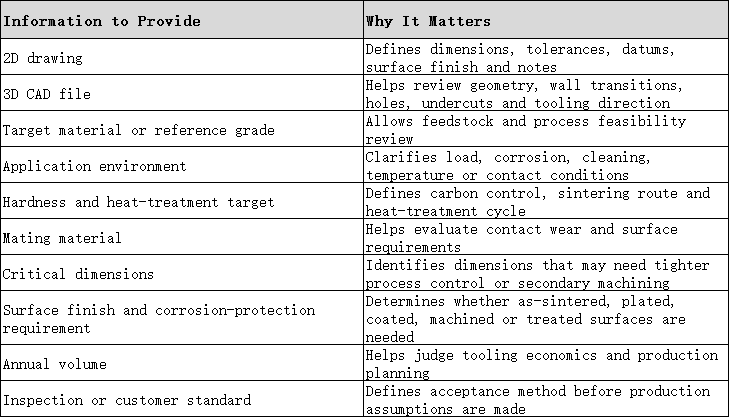
What to Provide for a MIM-4140 Material and Drawing Review
A MIM-4140 review should start before tooling. The goal is to identify material, carbon-control, geometry, heat-treatment and inspection risks while changes are still practical.
Before RFQ: What to Confirm for MIM-4140 Parts
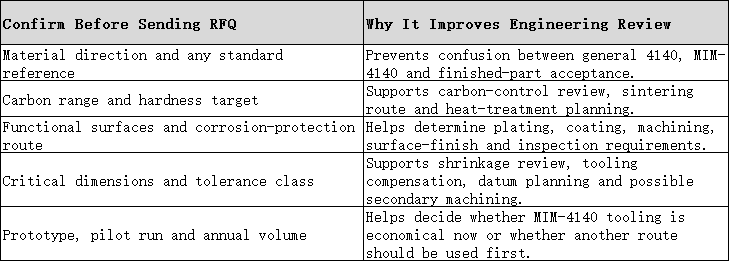
The most useful RFQ is not the shortest one. It is the one that gives enough engineering context for the supplier to identify risk before cost is locked into the tooling route.
Request a MIM-4140 Material and Drawing Review
If your project involves a small complex steel part requiring strength, toughness, wear resistance, hardenability, heat treatment or a cost-effective hardenable steel, send Harbermetal your drawings for an early engineering review.
Please provide 2D drawings, 3D CAD files, target material or standard, critical dimensions, tolerance requirements, hardness and heat-treatment targets, surface-finish and corrosion-protection needs, application background, mating materials, estimated annual volume, prototype or production stage and inspection requirements. Our engineering team can review material suitability, carbon-control strategy, MIM manufacturability, tooling risk, sintering and shrinkage concerns, heat-treatment distortion, secondary-operation needs, inspection requirements and RFQ feasibility before tooling or trial production.
Contact information
Email: sales@harber-mim.com
Tel: +86 0769-82389116
FAQ About MIM-4140 Low Alloy Steel
Can 4140 low alloy steel be processed by MIM?Yes, 4140 low alloy steel can be reviewed for MIM processing, especially when the part is small, complex and requires strength, toughness or hardenability. The real feasibility depends on powder and feedstock availability, carbon control during sintering, injection molding behavior, debinding, sintering, shrinkage control, heat-treatment response, surface finish and inspection requirements.
Does naming 4140 automatically approve a finished MIM part?No. 4140 is a material direction; it does not automatically guarantee finished MIM-part properties. Finished-part suitability depends on the customer drawing, specified manufacturing route, carbon range, density, heat-treatment cycle, surface condition, inspection methods, traceability and the applicable customer or regulatory validation requirements.
When should I choose MIM-4140 instead of MIM-316L or 17-4PH?MIM-4140 may be worth reviewing when you need cost-effective strength, toughness and hardenability and can provide corrosion protection (plating, coating or oiling). If you need corrosion resistance, 316L may be more practical. If you need high strength in stainless steel, 17-4PH may be more appropriate.
Is MIM-4140 better than 17-4PH for MIM parts?Not always. MIM-4140 is a low alloy steel that needs corrosion protection but is often more cost-effective for hardenability. 17-4PH is a precipitation-hardening stainless that offers strength plus corrosion resistance. The choice depends on function, service environment, hardness target and budget.
What are the main risks in MIM-4140 parts?The main risks include carbon loss during sintering (which lowers hardenability), feedstock availability, density, heat-treatment distortion, corrosion (without protection), surface finish, dimensional shrinkage and inspection definition. These risks become more important when the part has contact surfaces, tight tolerances or customer-specific material standards.
What information is needed for a MIM-4140 quotation?A useful quotation package should include a 2D drawing, 3D CAD file, material requirement, carbon and hardness targets, application environment, mating material, critical dimensions, surface-finish and corrosion-protection requirements, annual volume, prototype or production stage and inspection requirements.
Ready to evaluate MIM-4140 for your custom steel part? Submit your drawings and functional specifications for a free material and DFM review and transparent quotation.
Request A Free Quote