
 Deutsch
 Japanese
 English
 Korean
 français
 español
 русский
 português
 Italia

Stainless steel can be magnetic or non-magnetic — it depends entirely on its crystal structure, not on how much iron it contains.
Every stainless steel grade is iron-based, yet a 430 refrigerator panel grabs a magnet firmly while an annealed 316L sink does not. The difference is not "real steel versus fake steel." It is face-centred cubic (austenite) versus body-centred cubic (ferrite/martensite) atomic arrangement.
Three practical facts follow from this:
Roughly one family — ferritic and martensitic grades — is reliably magnetic. Austenitic grades (304, 316) are non-magnetic when annealed.
The same grade can behave differently. A cold-drawn 304 bolt often pulls a magnet weakly at the threads and head, while an annealed 304 plate does not.
A magnet cannot identify a grade. It can only screen the family. Grade confirmation requires a mill test certificate or alloy analysis.
Below we explain the metallurgy, the grade-by-grade behaviour, the four mechanisms that create "unexpected" magnetism, the correct test procedure, and what all of this means for MIM and sintered stainless components — an area most general guides ignore.
Key Takeaways
Magnetism is set by crystal structure, not iron content. All stainless steels contain iron; only some are ferromagnetic.
Austenitic (304, 316, 316L) = non-magnetic when fully annealed. Ferritic (430, 409) and martensitic (410, 420, 440C) = magnetic. Duplex (2205, 2507) = weakly magnetic. Precipitation-hardening (17-4PH) = usually magnetic.
Cold working (stamping, bending, drawing, thread rolling) transforms austenite into strain-induced martensite, creating weak magnetism.
Welding and casting can leave delta ferrite in an otherwise austenitic part, producing local magnetic spots.
A magnetic response does not mean the part is counterfeit, and it does not by itself mean the part will rust.
Magnetic grades such as 409 and 430 generally resist corrosion less than 304 or 316 — that correlation, not magnetism itself, drives the "magnetic = bad" myth.
Induction cooktops require a magnetic base layer. 18/10 austenitic cookware only works if a ferritic layer is clad into the base.
Grade and magnetic behaviour must be specified in writing if non-magnetic performance is a functional requirement.
1. Which Stainless Steel Families Are Magnetic?
Stainless steels are grouped by microstructure. Magnetism follows the microstructure almost mechanically.
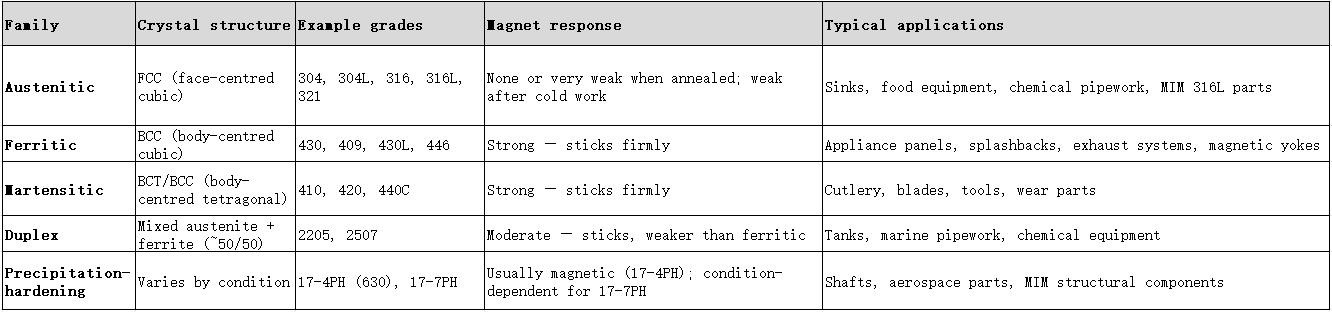
Why duplex behaves "in between"
Duplex steels contain roughly equal proportions of austenite and ferrite. The ferrite fraction is ferromagnetic; the austenite fraction is not. The result is a pull that is clearly felt but noticeably weaker than a 430 panel. In practice, most people holding a neodymium magnet can distinguish "strong" (ferritic/martensitic) from "moderate" (duplex) from "none" (annealed austenitic) — but not duplex from heavily cold-worked austenitic.
Relative permeability: the quantitative view
Magnetic response is formally described by relative permeability (μr). Approximate engineering values:

Values are indicative engineering ranges, not guaranteed material data. Actual permeability depends on chemistry balance, thermomechanical history, and for sintered parts, porosity. For magnetically sensitive designs (sensors, shielding, actuators), permeability must be measured on the actual production process route.
2. Why Crystal Structure Decides Magnetism — Not Iron Content
The three structures that matter
Iron atoms can arrange themselves in different lattices. Whether the resulting material is ferromagnetic depends on which lattice dominates:
Ferrite (BCC): The body-centred cubic lattice allows magnetic domains to align readily. Ferrite is strongly ferromagnetic with a Curie temperature around 700–770 °C.
Martensite (BCT/BCC): Formed when austenite is rapidly cooled or strained. It is a distorted, carbon/nitrogen-supersaturated ferrite and is also ferromagnetic.
Austenite (FCC): The face-centred cubic lattice is more densely packed, and the magnetic moments of neighbouring atoms cancel in an antiferromagnetic arrangement. Austenite is paramagnetic at room temperature — effectively non-magnetic to a hand-held magnet.
The practical consequence: any process that converts austenite into martensite or ferrite creates magnetism.
Why "nickel makes steel non-magnetic" is a misleading shortcut
A common simplification says "nickel makes stainless steel non-magnetic." It is half-true and often misapplied.
Nickel is an austenite former. It stabilises the FCC structure so that austenite remains stable down to room temperature. If austenite is stable, the steel is non-magnetic. If the nickel content is too low for the chromium and carbon/nitrogen present, austenite becomes metastable and partially transforms under strain — producing magnetism.
So the correct statement is: nickel stabilises austenite, and stable austenite is non-magnetic. Nickel is not itself a magnetic switch.
Two grades prove the point:
304 contains roughly 18% Cr and 8% Ni → austenitic → non-magnetic when annealed.
430 contains roughly 18% Cr and no nickel → ferritic → strongly magnetic.
Both have similar chromium content and similar iron content. The distinguishing variable is the austenite stabiliser balance.
17-4PH contains only about 4% Ni, is martensitic, and is magnetic despite the nickel. Its alloy balance does not hold austenite at room temperature.
The austenite stability rule of thumb
Austenite stability in 300-series stainless is set by a balance of:

If the austenite-forming side is marginal — as in lean 304 heats, high-carbon heats, or heavy cold-work conditions — the steel becomes prone to strain-induced martensite. This is why two "304" coils from different mills can respond differently to the same magnet.
3. Why the Same Grade Behaves Differently
This is the section most guides skip, and it is the one that causes the most confusion on the shop floor and in receiving inspection.
Mechanism A: Cold working creates strain-induced martensite
Stamping, bending, drawing, rolling, thread rolling and cold heading all inject plastic strain. In metastable austenitic grades, that strain triggers a partial austenite → martensite transformation. The transformed regions are ferromagnetic, so the part pulls a magnet weakly.
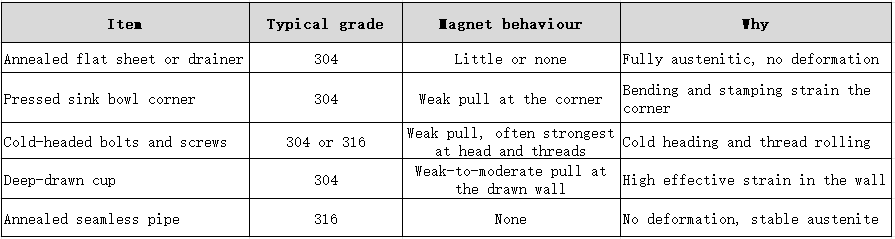
Key engineering point: the pull is usually localised. A magnet may stick at a bolt head and not at the shank. This is not a defect — it is a strain map of the manufacturing process.
The severity of the transformation depends on temperature as well. Deformation at sub-zero or winter workshop temperatures produces far more martensite than the same deformation at room temperature. This is why two identical production runs made in different seasons can measure different permeability.
Mechanism B: Welding leaves delta ferrite
During solidification, austenitic weld metal passes through a ferrite-containing phase field. Depending on cooling rate and filler-metal composition, a small fraction of delta ferrite (typically a few percent) can remain in the weld bead.
That ferrite is ferromagnetic. The result: an austenitic 304 assembly that is non-magnetic everywhere except a weak pull along the weld.
Residual ferrite in welds is not always undesirable — a controlled amount actually helps resist hot cracking. It simply means the weld zone reads differently on a magnet.
Mechanism C: Castings retain ferrite
Austenitic castings (often designated with a "C" suffix or as 304/316-type cast grades) commonly retain 5–15% ferrite to control solidification cracking and improve castability. Consequently, cast austenitic stainless parts are frequently magnetic unless solution-annealed, and sometimes even after.
If you are specifying a non-magnetic casting, say so explicitly and require verification — the default foundry practice is not to guarantee zero ferrite.
Mechanism D: Low-temperature behaviour and the Curie point
Two separate temperature effects exist:
Ferritic and martensitic grades lose their ferromagnetism above their Curie temperature (roughly 700–770 °C for ferritic stainless) and become paramagnetic.
Austenitic grades become slightly more magnetic at cryogenic temperatures, because the reduced thermal energy makes the austenite less stable and promotes martensitic transformation under stress.
Mechanism E: Composition within the grade range
Grade specifications define ranges, not single values. Two compliant 304 heats can sit at opposite ends of the nickel and carbon windows, with measurably different austenite stability and therefore different magnetic response after forming. This is normal metallurgy, not supplier dishonesty — but it is why buyers who require guaranteed non-magnetic behaviour must specify it as a controlled characteristic.
4. What This Means for MIM and Sintered Stainless Parts
This is the part of the topic most general articles omit, and it matters for anyone sourcing metal injection molded or press-and-sinter components.
4.1 Sintered 316L is usually non-magnetic — with caveats
MIM 316L is austenitic and, when correctly sintered and solution-treated, is effectively non-magnetic. However, three process factors can introduce a measurable response:
Residual porosity. Porosity does not create ferromagnetism, but it disrupts magnetic domain continuity and changes permeability and coercivity. A porous part can read differently from a fully dense one even at the same chemistry.
Powder contamination or off-chemistry heats. Iron-rich inclusions, or a lean austenite-stabiliser balance, can leave local ferritic or martensitic regions.
Mechanical operations after sintering. Tumbling, sizing, CNC machining, thread rolling or aggressive deburring all strain the surface and can produce a weak magnetic skin.
For most 316L MIM applications this is irrelevant. For magnetically sensitive applications — sensor housings, shielding cans, actuator components near a Hall-effect sensor — it is not irrelevant.
4.2 17-4PH MIM is intentionally magnetic
17-4PH (also called 630) is a martensitic precipitation-hardening stainless. In MIM it is one of the most widely used structural grades because it delivers high strength after aging at relatively low temperature, with good dimensional stability.
Because it is martensitic, 17-4PH MIM parts are magnetic — typically used deliberately in solenoid cores, actuator components, valve parts and instrument mechanisms where the magnetic response is part of the function.
What to control: solution-treatment condition, aging temperature and time, and final hardness. All three affect both mechanical properties and magnetic behaviour. If a customer needs a specific permeability or coercivity, it should be stated on the drawing and measured on the production route, not assumed from a material datasheet.
4.3 Soft magnetic MIM alloys — magnetism as the design intent
Where magnetism is the primary function, MIM offers purpose-built soft magnetic grades:
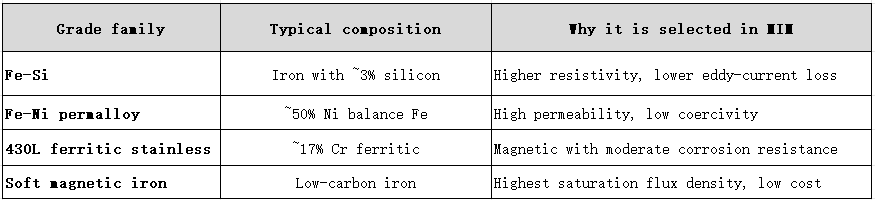
Typical MIM soft magnetic components include sensor yokes, solenoid armatures, magnetic cores, shielding housings and small relay parts — geometries that are small, three-dimensional and difficult to laminate or machine economically.
The MIM-specific variable that matters most: density. Porosity reduces permeability, increases coercivity and lowers saturation flux density. A 95%-dense soft magnetic MIM part will not match a fully dense wrought part of the same chemistry. If magnetic performance is a specified characteristic, density must be treated as a functional requirement — not a cosmetic one — and verified per batch.
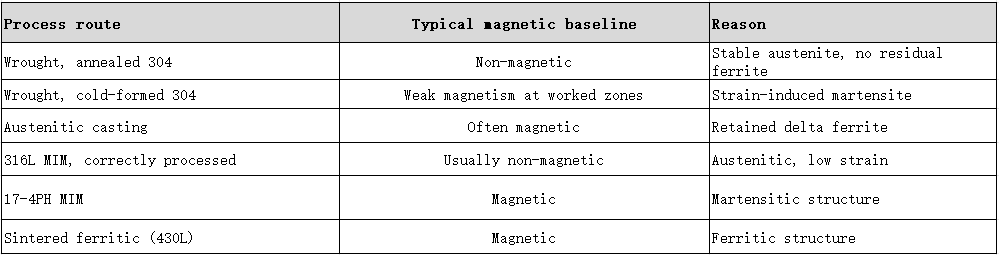
4.4 Cast vs sintered vs wrought: three different magnetic baselines
Buyers comparing a "304" part across processes should recognise that the process route, not just the grade name, sets the magnetic baseline:
4.5 What to put on the drawing
If magnetic behaviour is a functional requirement, the drawing must say so. A grade name alone does not control it. Recommended specification language:
"Material shall be non-magnetic in the as-supplied condition: relative permeability ≤ 1.05 at the specified test location."
State the test location and method — flat unworked area, annealed reference coupon, or measured permeability.
For soft magnetic parts, specify saturation flux density, coercivity, permeability at the operating field, and the density target that supports it.
For 17-4PH, specify heat-treatment condition (solution-treated + aged) and required hardness, since both affect magnetic response.
A MIM manufacturer that controls chemistry, sintering atmosphere, density and post-sinter strain can certify magnetic behaviour in writing. Vague requirements produce variable results — and arguments at incoming inspection.
5. How to Test Stainless Steel with a Magnet
A magnet test is a screening tool, not a grade identification method. Used correctly, it reliably separates "strongly ferromagnetic" from "effectively non-magnetic." Used carelessly, it produces false accusations of counterfeit material.
The six-step procedure
Clean the surface. Dirt, grease, oil and passivation residue reduce grip and produce false "non-magnetic" readings.
Use a strong magnet. A neodymium magnet, not a fridge magnet. Refrigerator magnets are too weak to reveal the faint pull of cold-worked austenitic steel.
Test a flat, unworked area first. This gives the baseline structure of the part without deformation interference.
Then test bends, edges, weld beads and bolt heads separately. Note any difference between the flat baseline and the worked zones.
Compare against a known reference. Hold the same magnet against a piece of plain carbon steel and against the test part. Relative pull is easier to judge than absolute pull.
Rate the result as strong / moderate / weak / none — and record where on the part you tested.
Interpreting the result
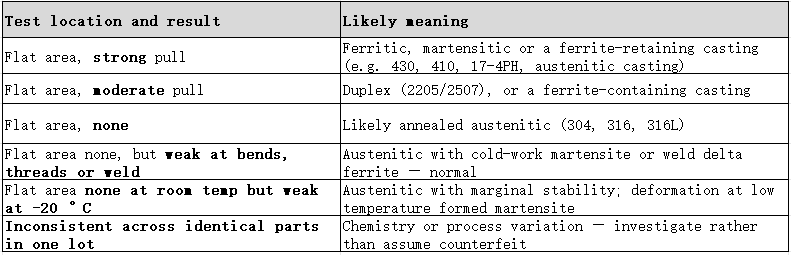
How strong is "strong"?
Quantitatively, a strongly magnetic stainless steel typically delivers roughly 80–99% of the pull that the same magnet produces on mild steel. So if a magnet holds 10 kg on mild carbon steel, expect roughly 8–10 kg on 430. Cold-worked 304 typically delivers a few percent — perceptible to a hand, but not comparable.
A hand-held magnet cannot resolve duplex from heavily worked austenitic. Both feel "weak to moderate." Do not use hand feel to make that distinction.
6. What a Magnet Test Cannot Tell You
This is where most counterfeit accusations go wrong. A magnet test cannot:
identify a specific grade (304 vs 316 vs 321 vs 347);
distinguish duplex from cold-worked austenitic;
confirm chemical compliance with any standard;
prove or disprove authenticity;
predict corrosion performance;
verify mechanical properties.
What to use instead
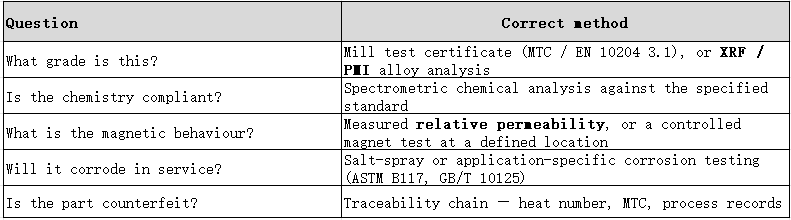
XRF/PMI will tell you chromium, nickel, molybdenum and other major elements in seconds. It will not measure carbon, nitrogen or interstitial content — those require combustion or inert-gas fusion methods. For full compliance, the mill certificate plus a targeted chemistry check is the correct combination.
For magnetically sensitive applications, permeability measurement on a representative sample from the actual production process is the only defensible verification. Reference coupons from a different process do not prove anything about your parts.
7. Does Magnetic Stainless Steel Mean Fake or Rust-Prone?
Magnetic ≠ fake
Magnetism has no bearing on whether stainless steel is real. A cold-worked 304 bolt that pulls a magnet is genuine 304. A 430 panel that sticks firmly is genuine 430. Both meet their specifications.
The myth persists because of a correlation, not a causation:
The most commonly encountered magnetic stainless grades — 409 and 430 — do resist corrosion less than 304 or 316, because they contain little or no nickel and lower alloy content overall.
People notice "magnetic" and "rusted" occurring together and conclude magnetism causes rust.
The truth is that the same low-alloy ferritic chemistry produces both the magnetism and the lower corrosion margin. Magnetism is a symptom of the structure, not a cause of corrosion.
Two magnetic parts, two completely different corrosion outcomes

Same magnetic reading, entirely different corrosion performance. This is the single clearest demonstration that magnetism is a structure indicator, not a quality indicator.
Does magnetic stainless steel rust?
It can, and the risk depends on grade and environment:
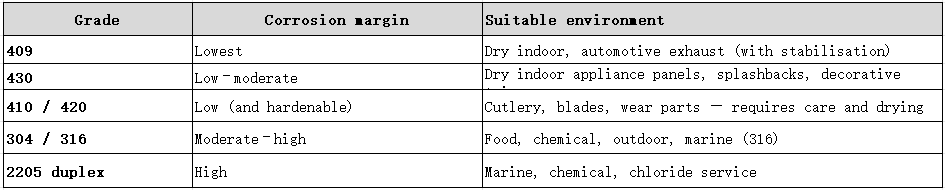
A 430 part used indoors in a dry environment performs adequately. The same 430 part in a coastal or chloride-rich environment will show staining far sooner than 316 — but that is an alloy-selection error, not a magnetism problem.
One industrial consequence worth knowing
Food-processing plants rely on magnetic separators to catch stray metal fragments. Work-hardened austenitic stainless fragments become weakly magnetic, which is precisely what allows the separator to capture them. In this context, weak magnetism in 304 is a useful property rather than a defect.
8. Does Stainless Steel Cookware Work on Induction Cooktops?
Only if the cookware base contains a magnetic layer.
An induction hob generates an alternating magnetic field, and heating occurs in a ferromagnetic susceptor through eddy currents and hysteresis loss. A purely austenitic pan — no matter how high its quality — will not couple to the field and will not heat.
The practical test
Hold a magnet to the base of the pan:
Sticks firmly → induction-compatible.
No pull → not induction-compatible on its own.
This is the only reliable check a consumer can perform.
The "18/10" misconception
The label 18/10 describes roughly 18% chromium and 10% nickel — an austenitic composition close to 304. Such steel is non-magnetic when annealed. Therefore:
A pan made of solid 18/10 stainless will not work on induction.
Induction-rated "18/10" cookware works because the manufacturer clads a ferritic stainless layer into the base — typically 430 or a dedicated magnetic grade — or because the base is a tri-ply construction including a magnetic outer layer.
So an 18/10 pan that sticks to a magnet is not mislabelled. It is an 18/10 body with a magnetic base layer, which is exactly how induction cookware is designed.
9. How to Choose Between Magnetic and Non-Magnetic Stainless Steel
The correct selection order is: environment and load first, magnetic behaviour second. Magnetism is rarely the primary design driver — but when it is a functional requirement, it must be specified as a controlled characteristic.
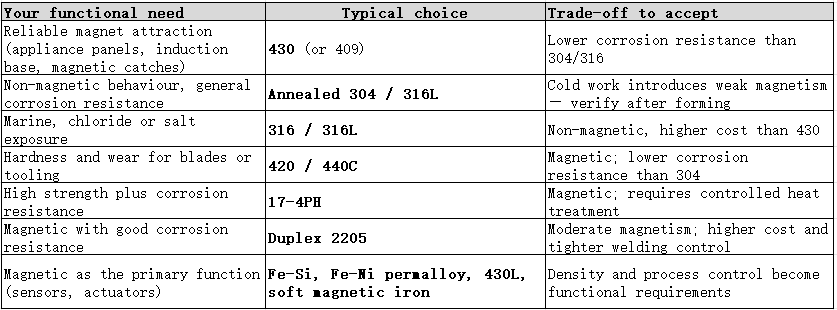
The engineering principle
Magnetism mostly comes along with the structure you chose for other reasons. You rarely select a grade for magnetism, except in magnetically functional components — soft magnetic cores, sensor yokes, shielding, actuator parts.
For those applications the rule is: choose a low-permeability (or specifically high-permeability) material, define the acceptance value, and measure it on the actual production route. Do not infer magnetic performance from a grade name.
How Harbermetal handles it
As a MIM manufacturer, we verify what the drawing requires:
Chemistry — powder lot certificate and spectral verification against the specified grade.
Structure and density — metallographic and density testing per batch, since both affect magnetic and mechanical behaviour.
Post-sinter strain control — process planning for sizing, machining and tumbling so that non-magnetic requirements are not violated after the last thermal operation.
Written certification — magnetic behaviour, hardness, density and dimensional results reported on the FAI and batch records when specified as a controlled characteristic.
If your part's magnetic response matters to function, put it on the drawing and ask for measured data. A grade name alone will not control it.
10. Frequently Asked Questions About Steel Magnetic
Is 304 stainless steel magnetic?
Annealed 304 is non-magnetic. Cold-worked 304 — especially bolts, deep-drawn parts and pressed corners — is weakly magnetic because strain transforms some austenite into martensite. This is normal and does not indicate counterfeit material.
Is 316 stainless steel magnetic?
Annealed 316 and 316L are non-magnetic. Cold working, welding and casting can introduce weak local magnetism. Heavily cold-worked 316 fasteners commonly show a faint pull at the head and threads.
Is 430 stainless steel magnetic?
Yes. 430 is ferritic and strongly magnetic. It resists corrosion less than 304 or 316, making it best suited to dry indoor applications such as appliance panels and splashbacks.
Is 410 or 420 stainless steel magnetic?
Yes. Both are martensitic and strongly magnetic. They are hardenable and used for cutlery, blades, tools and wear components.
Is 440C stainless steel magnetic?
Yes. 440C is a high-carbon martensitic grade, strongly magnetic, with high hardness after heat treatment. In MIM it is used for wear parts, blade components and bearing elements.
Is 17-4PH stainless steel magnetic?
Yes, in almost all practical conditions. 17-4PH (630) is martensitic and magnetic despite containing about 4% nickel. This is why it is widely used for MIM solenoid and actuator components where magnetic response is functional.
Is duplex stainless steel magnetic?
Yes, but weaker than ferritic grades. Duplex 2205 and 2507 contain roughly equal austenite and ferrite, so a magnet sticks but with noticeably less force than on 430.
Is 18/10 stainless steel magnetic?
Normally no. 18/10 describes an austenitic composition similar to 304, which is non-magnetic when annealed. An 18/10 pan that attracts a magnet has a magnetic ferritic base layer clad into it for induction compatibility.
Can a magnet damage stainless steel or make it rust?
No. A magnet does not alter microstructure, chemistry or corrosion resistance. Holding a magnet against stainless steel has no permanent effect.
Why does the same grade of stainless steel behave differently from part to part?
Because magnetism depends on structure and processing history, not just the grade name. Cold work level, forming temperature, welding, casting method, heat treatment and small chemistry variations within the specification range all shift the austenite/ferrite/martensite balance.
Is magnetic stainless steel lower quality?
No. Magnetic response indicates structure, not quality. A cold-worked 304 bolt is genuine 304 with unchanged corrosion resistance. A 430 panel is genuine 430 with genuinely lower corrosion resistance — a different alloy, not a worse version of 304.
Can cold-worked stainless steel be made non-magnetic again?
Yes. Annealing (solution annealing, typically around 1010–1120 °C followed by rapid cooling) restores the austenitic structure and removes strain-induced martensite. This is an industrial heat-treatment process, not a workshop fix, and it must be followed by controlled cooling to avoid re-forming martensite.
How can I confirm the grade if a magnet is unreliable?
Use a mill test certificate, XRF/PMI analysis for major elements, and laboratory methods for carbon, nitrogen and interstitials. For magnetically critical applications, measure permeability on production-representative samples.
Does sintering or MIM porosity affect magnetic behaviour?
Yes. Porosity reduces permeability, raises coercivity and lowers saturation flux density. For soft magnetic MIM parts, density is a functional requirement and must be specified and verified — not treated as a cosmetic characteristic.
Conclusion
The question "is stainless steel magnetic?" has a precise answer that most one-line guides miss: magnetism is a property of crystal structure, and crystal structure is set by composition plus processing history.
Use this three-part checklist on your next project:
Identify the family, not just the grade. Austenitic = non-magnetic when annealed. Ferritic and martensitic = magnetic. Duplex = weakly magnetic. PH grades = usually magnetic.
Account for processing. Cold work, welding, casting and low-temperature forming all change the magnetic reading. A weak pull at a bolt head is normal, not a defect.
Specify what matters. If non-magnetic or specific magnetic performance is functional, put it on the drawing with a test location, method and acceptance value — and require measured data from the production route.
And remember the two things a magnet can never establish: the grade and the authenticity. Those require a mill certificate, alloy analysis, or a permeability measurement — evidence, not a fridge magnet.
Need to verify magnetic behaviour on a MIM component?
Send your drawing, required grade, magnetic acceptance criteria and application context. Harbermetal can review material selection, sintering and density strategy, post-sinter strain control, and reporting requirements — and confirm whether the specified magnetic behaviour is achievable on the production route before tooling.
Contact information
Email: service@harber-mim.com
Tel: +86 0769-82389116
Request A Free Quote